


Endodontic instrument retrieval remains one of the most technically demanding procedures in root canal treatment. When a separated Lentulo fragment lodges in the apical third, clinicians must balance efficiency with safety to avoid further complications. In this clinical case, Dr. Olga demonstrates a predictable, single-visit approach to Lentulo fragment removal from the mesiobuccal canal of a maxillary first molar.
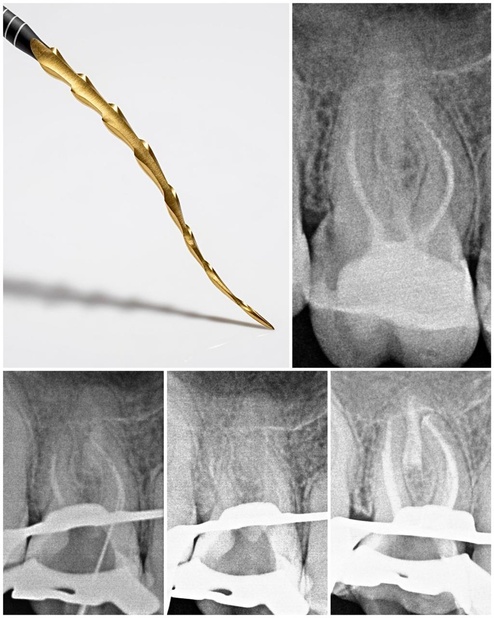
Case Diagnosis
Tooth: Maxillary first molar
Issue: Separated Lentulo fragment located in the apical third of the mesiobuccal (MB) root canal.
Main Challenge
The primary difficulty was safely bypassing the fragment and creating adequate space for retrieval without causing canal blockage or risking a secondary file fracture. Excessive pressure or aggressive instrumentation in this delicate apical zone could easily lead to ledge formation, perforation, or additional instrument separation.
Step-by-Step Clinical Procedure
- Bypassing the Fragment
The Lentulo fragment was successfully bypassed using a #10 K-file. This initial step is critical as it creates a pathway alongside the fragment, allowing controlled dentin removal. - Canal Preparation with Dual Shape Rotary System
Space adjacent to the fragment was carefully prepared using Denco Endo Dual Shape rotary files. The sequence included:- 016
- 20/.04
- 25/.04
- All files were operated at 300 rpm with a torque setting of 2.0 N·cm.
- The unique single-beveled cutting edge design of the Dual Shape instruments played a decisive role. This feature enabled highly controlled and safe dentin removal, significantly reducing the risk of canal blockage and preventing secondary instrument fracture.
- Fragment Retrieval
Once sufficient space was created, the Lentulo fragment was safely removed using an IRRISafe #20 ISO ultrasonic tip (Acteon). - Final Preparation and Obturation
After thorough irrigation and final canal shaping, the root canals were obturated in the same visit using a bioceramic sealer and gutta-percha.
Treatment Outcome
- Successful bypass achieved with #10 K-file
- Safe and efficient shaping with Denco Dual Shape rotary files thanks to the single-beveled cutting edge
- Complete fragment retrieval via ultrasonics
- Single-visit obturation with excellent sealing
This case highlights how proper instrument selection and technique can transform a high-risk instrument retrieval scenario into a predictable success.
“Precision over pressure. Dual Shape turns high-risk retrieval into predictable, single-visit success.”
— Dr. Olga
Why This Matters for Modern Endodontics
Lentulo paste carriers are useful but can separate if mishandled, especially in curved or narrow canals. Cases like this underscore the importance of having reliable rotary files with intelligent designs — such as Denco Endo’s Dual Shape system — that prioritize safety and cutting efficiency in challenging retreatment situations.
Clinicians performing endodontic retreatment and broken instrument removal can benefit from techniques that emphasize bypassing, controlled enlargement, and ultrasonic activation while minimizing procedural risks.