Double Curve, Single Choice: Kite Gold in Maxillary Premolar
Complex Anatomy Management | Clinical Case Report by Dr. Sabina Banicka (Poland) Master in Aesthetic Medicine | Master in Endodontics
Introduction
Managing root canal systems with severe anatomical challenges remains one of the most demanding aspects of modern endodontics. When a tooth presents acute double curvatures, the risk of instrument separation, canal transportation, or incomplete cleaning increases significantly. This case report demonstrates how the DENCO Kite Gold rotary system enabled safe, predictable shaping of a maxillary second premolar with exceptionally difficult canal anatomy.
Patient Assessment & Case Challenge
A 50-year-old female patient presented with exacerbated chronic apical periodontitis and a submucosal abscess.
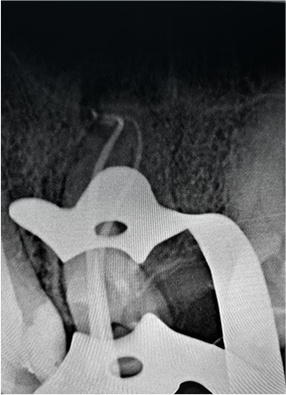
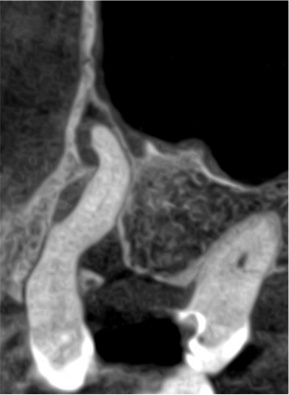
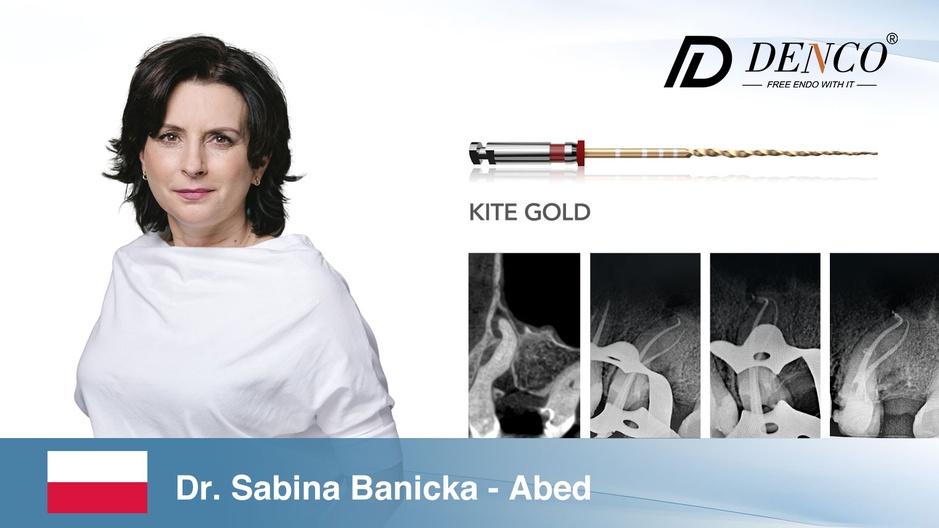
Pre-operative radiographic evaluation using RVG and CBCT of tooth 25 (maxillary second premolar) revealed:
Two root canals
Acute, superimposed double curvatures
Associated periapical lesion
The primary clinical challenge was clear: how to safely navigate and shape two canals with acute double curvatures to full working length without deviation, ledging, or instrument fracture.
Clinical Procedure
Mechanical Shaping
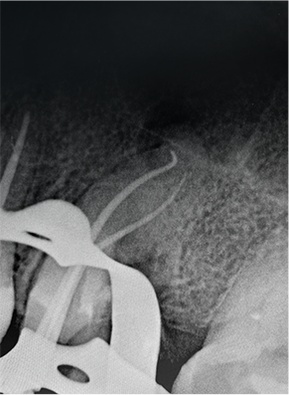
Mechanical preparation was performed exclusively with the KITE GOLD rotary system (DENCO) following the manufacturer’s recommended protocol:
Torque: 2.0–2.5 N·cm
Speed: 300–400 rpm
These settings allowed controlled, progressive advancement through the highly curved canal system while maintaining the original canal path. The inherent flexibility of the Kite Gold instruments enabled them to follow the double curvature anatomy without forcing or transporting the canals.
Irrigation Protocol
Thorough chemical disinfection was achieved using:
5.25% sodium hypochlorite (NaOCl)
17% EDTA
This combination ensured effective dissolution of organic tissue and removal of the smear layer throughout the complex canal morphology.
Obturation
The prepared canals were obturated using the warm vertical compaction technique.
Outcome
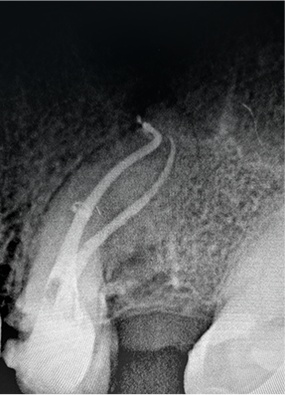
The post-operative radiograph confirmed a dense, three-dimensional obturation of the entire endodontic system. Full working length was reached in both canals — an outcome that many conventional rotary systems would struggle to achieve safely in such anatomy.
Clinical Reflection
Thanks to their advanced metallurgy and design, Kite Gold instruments are highly flexible, work gently, and closely follow the natural curvature of the canal. This characteristic proved decisive in managing one of the most demanding canal anatomies encountered in daily practice.
“When one curve isn’t enough, Kite Gold takes both.”
Key Takeaways
Kite Gold rotary files demonstrated superior flexibility in double-curved maxillary premolar canals.
Manufacturer-recommended settings (300–400 rpm / 2.0–2.5 N·cm) provided a safe and efficient working range.
Combined with proper irrigation and warm vertical compaction, complete three-dimensional obturation was achieved.
In cases of complex anatomy, instrument selection remains a critical factor for predictable endodontic success.
Author Dr. Sabina Banicka Poland Master in Aesthetic Medicine | Master in Endodontics