










 Home
Home



Replaceable Gutta
Percha Plugger
Learn More


Author: Dr. Gabriele Ragucci
Location: Italy
Category: Conservative Shaping · Curved Canal Management
Successful endodontic treatment relies on effective cleaning and shaping while preserving the original root canal anatomy. Heat-treated nickel-titanium (NiTi) instruments have significantly enhanced the safety and predictability of root canal preparation, particularly in anatomically complex teeth. This clinical report describes the use of the DENCO Chameleon Dual Shaper heat-activated rotary file system in the treatment of a maxillary premolar diagnosed with symptomatic irreversible pulpitis.
The tooth was a maxillary premolar presenting with symptomatic irreversible pulpitis. The buccal root canal exhibited narrow anatomy with an abrupt curvature, requiring flexible yet controlled instrumentation. Maxillary premolars frequently present anatomical variations, including narrow canals, abrupt curvatures, and occasional bifurcation of the root canal system. Therefore, instrumentation systems that combine flexibility with high resistance to cyclic fatigue are particularly advantageous in these cases.
The central clinical challenge was clear: how to achieve a centered, continuously tapered preparation in a curved premolar canal without transportation, while preserving pericervical dentin through a conservative 4% taper. Maintaining the original canal pathway and maximizing remaining dentin structure were essential for both short-term safety and long-term tooth strength.
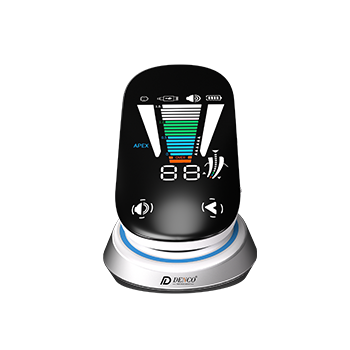
After administration of local anesthesia and rubber dam isolation, a conservative access cavity was prepared under magnification. Canal patency was established using a #10 K-file. Working length was determined with an electronic apex locator and subsequently confirmed radiographically. This careful approach ensured accurate length control before rotary instrumentation began.
Root canal shaping was carried out using the DENCO Chameleon Dual Shaper sequence: SX, 20/.04, 25/.04 and 30/.04 (25 mm). Instrumentation was performed at 150–300 rpm with a torque setting of 1.5–3.0 N·cm, following the manufacturer’s recommendations.
The heat-activated NiTi alloy provided excellent flexibility and controlled canal negotiation, particularly in the curved buccal root. This allowed a centered preparation while minimizing the risk of canal transportation. The conservative 4% taper offered a shaping philosophy that preserved pericervical dentin without compromising the space needed for effective irrigation.
These material properties — heat treatment, enhanced flexibility, and controlled cutting efficiency — enabled the files to track the original canal anatomy closely. The result was a continuously tapered preparation suitable for three-dimensional obturation, achieved with minimal removal of tooth structure.
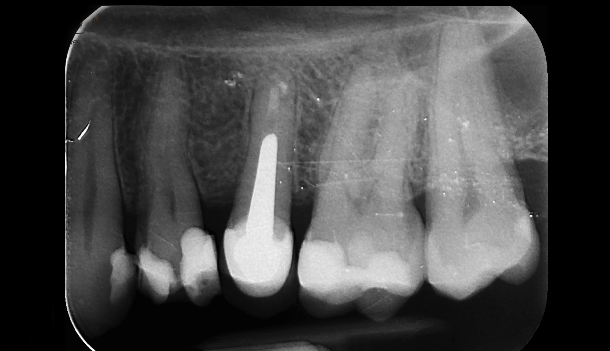
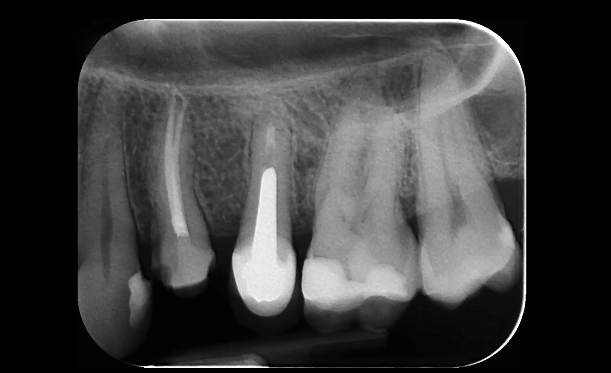
Copious irrigation with 5.25% sodium hypochlorite was performed throughout instrumentation. This was followed by a final irrigation protocol using EDTA and sodium hypochlorite activation. Even with the conservative 4% taper, the irrigation regimen remained effective, supporting thorough disinfection of the root canal system.
The combination of precise shaping and active irrigation ensured that chemical cleaning was not limited by the minimal taper. This balance between mechanical conservation and chemical efficacy is a key advantage of modern heat-treated systems designed for minimally invasive preparation.
Apical preparation was completed according to the canal morphology, resulting in a continuously tapered preparation ready for three-dimensional obturation. The heat-activated alloy of the DENCO Chameleon Dual Shaper negotiated the curved buccal canal with centered tracking and zero transportation. The conservative 4% taper preserved pericervical dentin while still allowing effective irrigation with 5.25% NaOCl and EDTA.
These characteristics make the system particularly suitable for the management of vital pulp cases that require minimally invasive yet efficient canal preparation. The files delivered excellent flexibility and cutting efficiency while consistently respecting the original canal anatomy — an essential requirement when treating curved and narrow premolar canals.
Within the limitations of this clinical report, the DENCO Chameleon Dual Shaper rotary system demonstrated excellent handling characteristics during the treatment of a maxillary premolar with symptomatic irreversible pulpitis. The heat-treated NiTi alloy, conservative taper, and enhanced flexibility allowed safe and predictable canal shaping while preserving root structure.
The case illustrates how modern heat-activated instruments can support both biological principles and practical clinical demands: centered preparation, reduced risk of transportation, and maximal preservation of pericervical dentin. Additional clinical and laboratory studies are needed to further validate the long-term performance of this instrumentation system.
Conservative taper. Confident tracking. Chameleon Dual Shaper.